
You know, a good podcast can go a long way. As someone who is on their own journey to creating their first podcast, I can now say I’ve got a lot of work to do. But a challenge is always welcome here. Through trials, research, and script writing, this article goes through the creation of my podcast idea and its eventual execution. Welcome to the start of Activation of AI Regulation!
Why AI Regulation?
AI has always been an interesting subject to me, especially its regulation. As I looked for a topic, I realized how limited AI regulations are in the US. While some new laws exist, mainly focused on data protection, one area stands out and drives my interest.
That area was AI vs Copyright and how even at the time of writing this, there are essentially no regulations on how AI uses other’s work. This area especially means a lot because I have seen how stolen work and branding through AI has affected others. So I found that discussing the subject would be great for the podcast idea.
But every good podcast needs to start somewhere. I begin preparing the script.
Crafting Your Script
Because its my first time, the goal for me was learning to make a script. As a result, I wanted to learn about the different methods and techniques to create one. The readings below tell of my journey of what I learned and took most about podcast script writing and overall techniques that will help in the perfect podcast.
The Bare Bones Camera Course: Chapter 8- Sound
Bare Bones Camera Course for Film and Video was certainly an investing time. The first half of the chapter on Sound followed frequency and the types to look out for. Frequency plays a big role in podcasting because, like humans, technology uses frequency to detect sound. It is location and sound waves that will affect how frequency hits people and microphones.
The chapter then explores the best methods of capturing sound. There are multiple types of microphones (for example, the all-purpose band mike) and types of sounds that can be picked up (such as the omnidirectional pickup pattern). Sound is everything. You must constantly think about what affects sounds, like location, reverberation, background noise, and more.
I think the most important thing I took from this chapter was the end. The author, Tom Schroeppel, talks about how you must think of the listener most of all. You shouldn’t make our audio annoying or difficult for viewers. You are making the audio for them, so at the end of the day, you must make sure that you do your best with your audio.
The Art of Creating an Invisible Podcast Episode Script
Now, imagine you are talking to a friend right now. I’m sure no matter who you pick, you know how the conversations go. You laugh, you understand each other, no matter the direction. Congratulations! You now know how an invisible script works. Making an Invisible Script explained how to rewrite a script for a podcast, but make it sound natural to the audience, it must be like it’s never there to begin with, “invisible”.
Having an invisible script means talking to your audience like you know them. On one hand, the article recommends having your key points (welcome message, topic intro, etc.) as a way to make a linear path for the script, but also to understand the power of narrative flow. You must sound like you know the audience. Put breaks in the script to sign, be short and simple.
I think my favorite recommendation for script writing came from this article, too. I know, a bit early. They recommended that you question if your script sounds like you. Like if a friend of yours heard the script, they’d know it’s you. This was a great article to start with.
Creating a Great Podcast Script: 3 Methods Top Podcasters Use
Now that you know how sound works, let’s talk about how to organize and write the script. There are many methods that podcasters can use but the 3 Methods Top Podcasters article provides three versions of writing for anyone to use, whether it’s your first time or not. The story taught me the following:
- Word-for-Word Writing: This first method is pretty self-explanatory. Podcasters write down word-for-word what their script will say. While the content from this method creates a script that’s clear and concise, the tone may feel bland, sounding unnatural.
- Detailed Podcast Outline: The second method follows 2 steps: You start with 5-10 ideas, bulleting them down. Then you pick the best ideas and write brief explanations on how they work. The Detailed Podcast Outline is good for ideas and lets you stay on a path naturally. There can be times when distractions appear.
- Bullet Point Plan: This last method is more open than the others. It is a simple bullet point list of what you will talk about. This method is great for having the most natural way of talking to the audience. However, its system may cause users to lose track of the plot.
Despite having different ideas, any can work for your podcast. The goal of these methods is to learn, to prepare yourself for your writing. If one method works better than another, then that’s okay.
Podcast Taglines, Hooks, & the Power of Words
If you want the audience to stay in your podcast, you need a hook that brings people in. And that’s not an exaggeration. Podcast Taglines, Hooks and the Power of Words explains how podcasts need a statement that makes you different from the rest. And there can be a lot of types of wording that can help make you stand out.
- Tagline: A simple statement, like an introduction to your podcast.
- The Two-Step: Two statements that separate your intro. Brings a more dynamic feeling to the classic tagline.
- The Bio Format: An explanation of who you are and the plot.
- Hook: A statement that gets viewers’ attention. It can be anything from a call to action, sponsorship, or sketch.
I definitely will be learning this article’s ideas. The tagline and hook to stand out the most to me because they have to be direct and simple, while being eye-catching at the same time. As someone making an educational PSA, I have to be direct, but I will need a way to make a tagline and hook that gets the viewer immediately.
Best Podcast Tools of 2025: Make, Market, & Monetise Your Show
Perhaps you don’t know what tools could be beneficial for making your podcast. Well, I was in luck with Best Podcast Tool of 2025. This article goes in-depth about tools to help in podcast making. They listed a lot of good ideas , from editing tools like Alitu and EditPoint, to website creators like Podpage and even newsletter senders like Beehiiv.
However, my persona favorite go to The Podcast Host Planner and Samson Q2U microphone. Since this is my first time creating a podcast, a planner goes a long way, and the Host planner helps users journal and schedule their podcasts. Meanwhile, the Samson microphone is a universal and affordable microphone. It allows the person to stand amongst the great audios that exist out there. All the tools ultimately serve to make podcasters’ lives just a bit easier.
Podcast Presentation Skills | Honing Your Speechcraft
While making a script is vital, your speech is just as important. In Podcast Presentation Skills, we follow skills that serve not only to help with your speech in podcasting but also to help build confidence as time goes on.
The first section starts strong: the Script and the Presenter. This means that when you are working on a podcast, having a script and being communicative to the audience are the most important things to worry about. The writer mentions ideas like remembering to breath when reading and to be open narratively.
The second half is just as important, focusing on the struggles of speaking. The writer tells the viewer not to worry about the anxieties and fears that come with speaking to the public. That its okay if you mess up or forget. Making a podcast script and learning to say it takes time, and you will improve as time progresses. So cut some slack. Everyone gets to the finish eventually.
Inspirational Podcasts
Because my podcast is based around AI and law, finding the right way to talk to my audience was critical. I had to find inspiration where I only listened to their voices, not the visuals. This is because one, my podcast is audio only, and two, even if it wasn’t, it would have been likely that people would listen to my audio only. So I found inspirations that were a good mix of clarity and fun. I also wanted to answer some questions as I listened.
- How did they get the viewers’ attention in the beginning?
- Do they have background music or noise?
- How often do podcasters use sound effects?
- Do they have a theme or style?
- How do they speak? Is there clear emphasis in their voice or voices?
1. 99% Invisible: Speaking and Sounds
I think if there’s a style of speaking and feel that I want to learn from, it’s 99% Invisible. Following their 2nd episode on Hidden Video Game, Invisible goes in-depth about console joysticks and their adventure on learning the different types through history. What I liked most about the content is the atmosphere.
Genuinely, it feels like learning about a video game. The creator speaks clearly, with segments and music mixed in at perfect times. It never feels too quiet or too overwhelming. The way they take is educational and clear, but also matches the enthusiasm they have for the games. I think it’s perfect for setting a benchmark of what to look out for in a podcast.
2. Life Kit: Timed Music
Another example I thought was good was Life Kit’s podcast, specifically her Teens Using AI episode. I really liked her a lot because of her timing and especially how she utilized music in her episode on AI. Her tone stays neutral throughout the episode, and while I wasn’t a fan of the speech, the timing of the music made everything come together.
When she’s talking about a lighter topic, the music is more welcoming. Even in more pressing topics of AI’s effects on teens, her music helps convey her worry. It’s even more impressive when she uses that music to her advantage. When she is discussing hard topics, she cuts them off entirely. There’s a part at the 2-minute mark that struck me. When she talked about how AI has caused physical harm to teens, she turned off the music, because it’s an important topic that shouldn’t be taken lightly.
3. Distractible Podcast: Opening Style
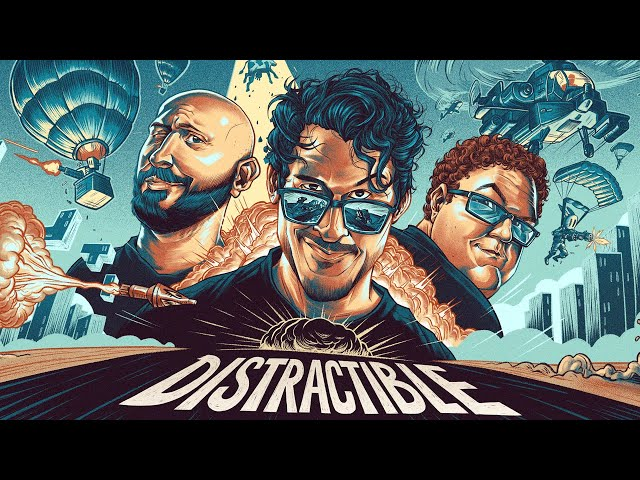
If you want a fun and unique opening, I highly recommend listening to any opening from the Distractable Podcast. The episode I listened to from them is on Artificial Intelligence, as I figured they would be discussing a topic like mine. I chose these guys as inspiration because of their opening style. Each episode opens with this 1920s-style opening. The opening is really unique but also immediate. They got my attention right away.
Despite their opening being great, I can’t take inspiration from their editing. They are 1. a visual podcast and 2. Don’t use sound effects. This does work for them, but for an audio-only project, their style of editing and sound is limited. On the bright side, they are very clear and concise. They also have great back-and-forth with each other, so their speech feels natural.
4. No Such Thing As A Fish: Vibe and Tone
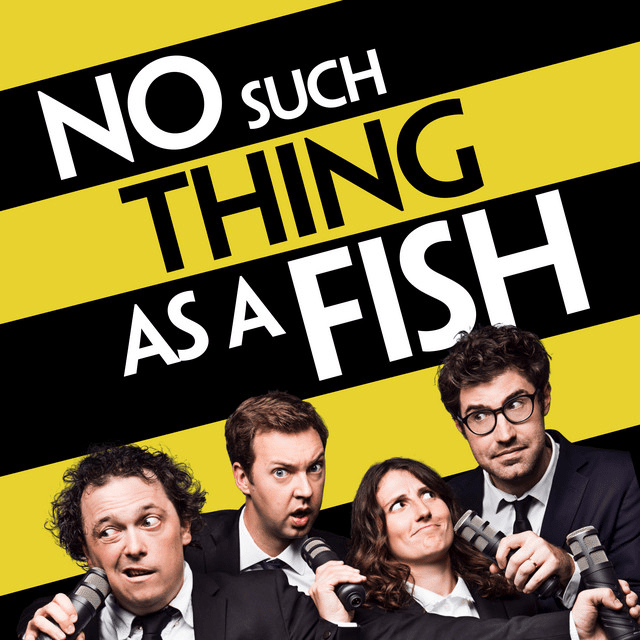
Despite being a group of 4, I love the setting and tone of No Such Thing As A Fish. Their episodes consist of talking about the most stuff known to man, but they are also investing at the same time. Despite going on so many different tangents, they know how to get a good laugh out of each other and know how to bring fun into their lives.
What impressed me the most was the tone of their voices. Despite only listening to them, they all sound invested in their topics when talking. And they also sound informational while being hilarious. I mean, the one I listen to is about clowns and dinosaurs. They have no correlation, but the podcasters’ discussions make it seem like the most interesting thing in the world. I can get behind that.
Setup of a Mind-map
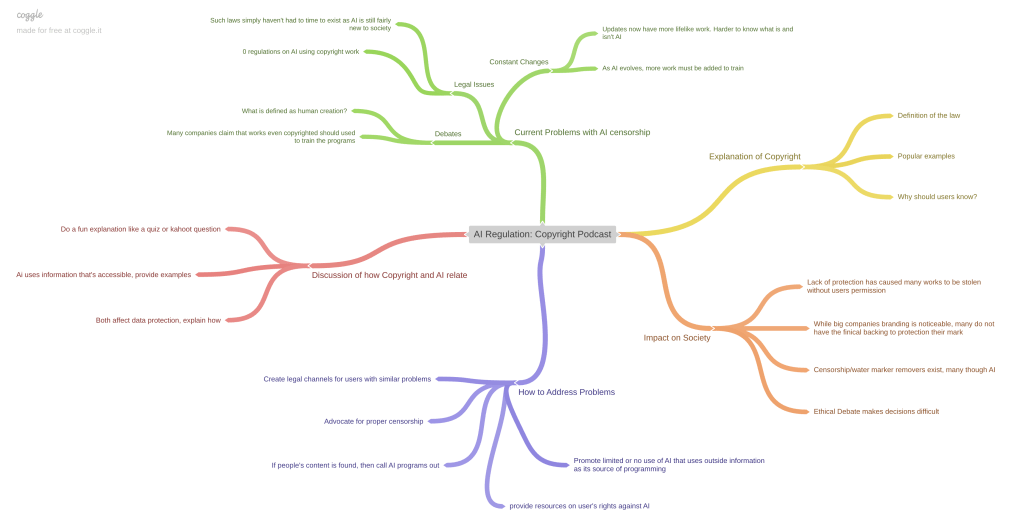
As a way of analyzing what I hope to discuss in my podcast, I also created a mind-map as a visual guide of the topics I want to explore. I really wanted to discuss on how AI and Copyright are stuck in a huge debate, and because it hasn’t been solved yet, its resulted in problems for the legal system and is causing such problems for all creators out there. The mind-map organized my thoughts best, and made discussing this topic to be easier for when I created the script.
Finalizing Podcast Preparations
For me, a lot of thought went into the final script and other preparations. I had a vision going in, and I wanted to go all the way for it. I was nervous at first because I was worried that I wouldn’t have the necessary tools to make a good podcast.
Now that my preparation is complete, I feel confident. My topic deserves more attention, and I hope to inspire positive change in AI copyright regulation.
Thank you for following me on this journey, and here’s the final below!
 The Simple Look
Leave a comment