
Did you ever brainstorm ways to make an idea happen as a kid? That early brainstorming was actually ideation at its heart, a process for turning thoughts into actionable plans.
But what does that look like in a professional field? Well, this week, I had the pleasure of seeing what can come out of ideation. Using POV statements for YouTube, Spotify, and TikTok, I experienced how ideation techniques can bring out all types of solutions for problem-solving issues.
What Makes Ideation Techniques the Best Idea Generators?
Complex ideas don’t just pop out of thin air. As I reviewed my POV statements, I realized that not every idea generator suits the specific problem at hand. This is the strength of ideation techniques: many exist, each offering distinct and creative ways to generate ideas.
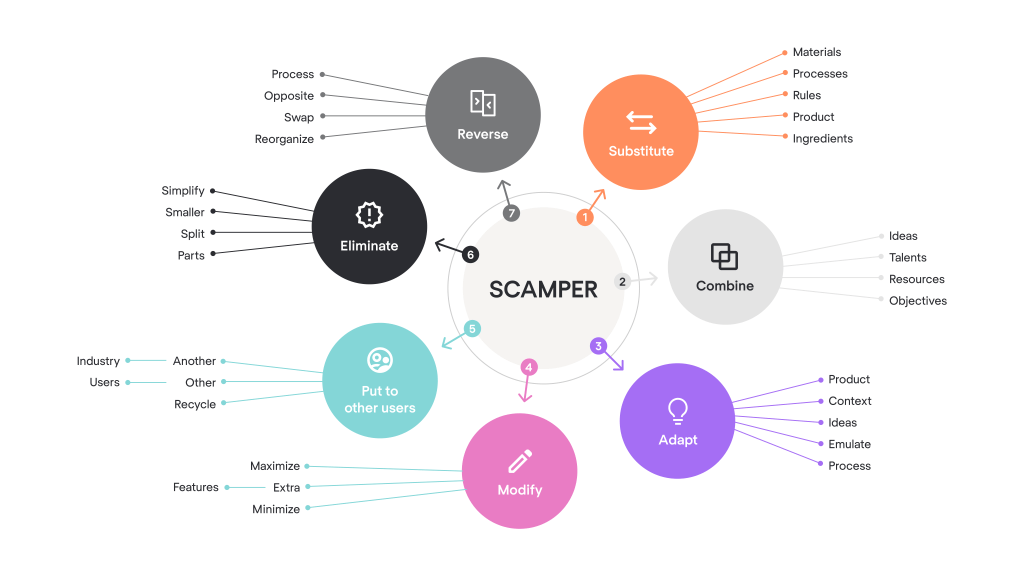
The only thing that most people are familiar with is Brainstorming, where you collect the best ideas by yourself or in a group. But there are others that should be considered as well! For writing, Brain-dumping, Analogies, or SCAMPER are good methods. Or you may prefer visual techniques like Sketching, Storyboarding, or Mind-mapping.
Ideation for YouTube
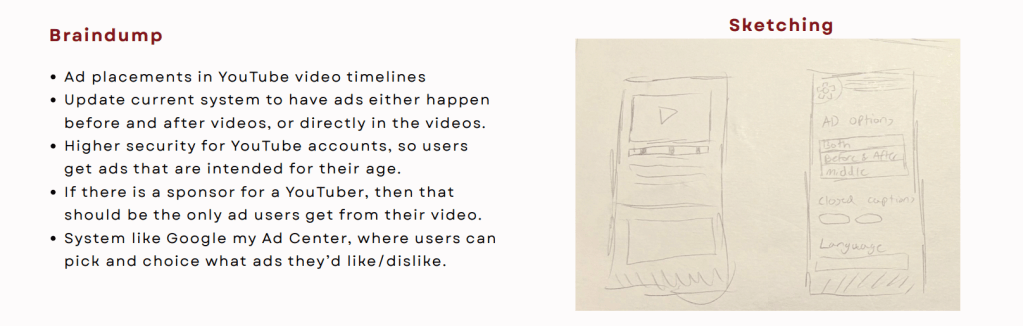
My POV statements for YouTube focus on 1. YouTube’s advertisement control and 2. accessibility to preferences like closed captions, auto play, and playback speed. For POV 1, I chose Braindump and Sketching as my main ideation techniques. Braindump is helpful because I can write down any idea and just write down whatever comes to mind, while Sketching provides a visual representation of the two best ideas.
For POV 2, I chose Braindump and Storyboarding. Once again, Braindump allowed for all types of ideas to be out. However, I wanted to see how a user would get from video to preference. Storyboarding is perfect for showcasing how a person is going through an event, in my case, changing their preferences through a new button.
Ideation for Spotify
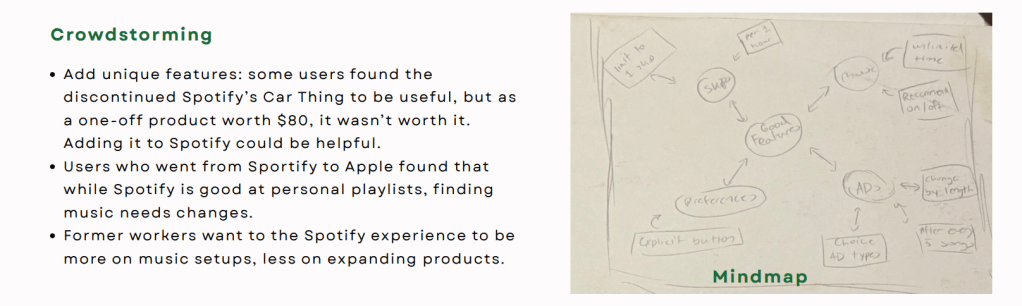
My POV statements for Spotify focused on 1. fixing Spotify’s free interface, and 2. Having hidden content features. The best options for POV 1 were Crowdstorming and Mind-maps. I wanted to look at other sources of ideas, So I read about discontinued products and users who switched platforms. I learned that new features could be added to make the free interface better, like adding Spotify’s Car Thing (which allowed for easy access on devices that were older). Mind-maps were helpful because they allowed me to expand on solutions for the different parts of the interface.
POV 2’s best options were Challenging Assumptions and Mind-maps. By challenging these assumptions, I noticed solutions that could help, like how there isn’t a rating system for songs like there is on radio stations. Mind-maps were also helpful here because I could add feature placements on where such a feature could go in Spotify.
Ideation for TikTok
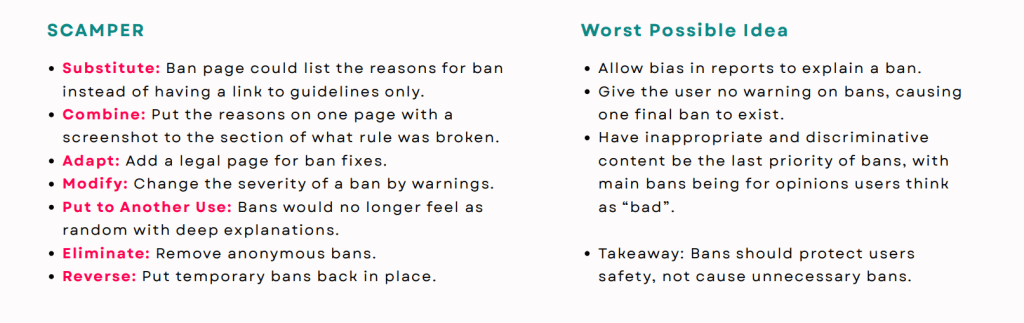
The POV statements for TikTok were on 1. how to solve the lack of ban information, and 2. having an auto play feature. POV 1’s best techniques were SCAMPER and Worst Possible Idea. Of all techniques so far, SCAMPER (Substitute, Combine, Adapt, Modify, Put to another use, Eliminate, and Reverse) is the most unique. It helped provide a way to manage an idea through adapting, eliminating, and substituting elements of how a ban could work. Worst Possible Idea was the other technique because I had to think of ideas that would never work well for bad information, thus showing what a user would want for a solution.
For POV 2, the best ideas were SCAMPER and Sketching. This time, SCAMPER helped manage an auto-play feature for TikTok. Where would it go? What could be replaced? Should anything change? Sketching let me visualize a place for an auto play feature, with the best locations being in the share feature or in the top corner.
What You Can Learn From Ideation
If you are taking anything from ideation techniques, please know that the technique depends on your idea. The different ideation techniques worked as well as they did because they provided the techniques for the POV statements. Some ideation techniques could work in others, but each was dedicated to the best possible outcome.
Don’t overlook this stage. Ideation is not just about generating ideas; it’s about developing and understanding them. Using multiple techniques provides you with ideas you might not have considered. Embrace ideation to recognize and refine your best ideas—the more you explore, the more outcomes you will have.
Here’s my full analysis if you want to read it!


 The Simple Look
Leave a comment