

I think it’s safe to say that everyone knows that within the media, a map is often used to locate a final destination. I grew up watching movies where the main characters use a map with a huge X in the middle to find their “treasure”. But I always wondered. Who makes them? Why a map of all things? What was the power of a map?
Most importantly, what does that have to do with me now? Well, I have to make them! It’s weird to say but yeah, I make maps to get to my treasure of an effective design sprint. And I think back to those movies and games because, despite the great treasure at the end, it’s the map that holds the power. Here’s why design sprints need the power of a map.
A Map is the Vision
In a design sprint, you aren’t given a lot of time. Within your short period, you need to figure out how to accomplish everything within your limited days, from sketching to designing to prototyping to presenting. You need something that leads to that end goal. And with a shocking turn of events, it’s a map that gets you there. The Sprint Handbook explains it best:
“The map of the Sprint will serve as a guide to select a focused area of the product/ customer. Through refinement and teamwork, this map can also be a well-constructed system that helps define the scope of your problem.”
It’s simple really: the Vision, the Journey, and the End.
A Map is the Journey
You are also not making a map alone. This ain’t treasure you’re going to steal at the end, this is every man’s gold. Part of what makes a design sprint map so effective is that it’s everyone’s input that matters. You are discussing all day with designers to get a greater understanding of what everyone wants and can do.
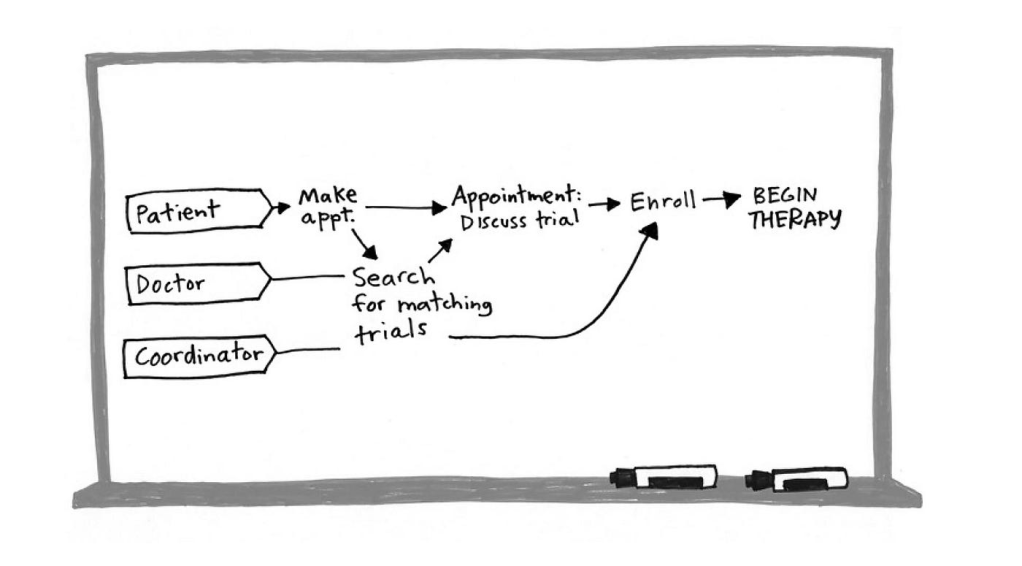
That’s confusing! I hear your cries but there’s a great solution. If you want to make a great map, then I think Sprint is a great book to check out! Within Day 1, author Jake Knapp explains that when you plan for the design sprint, you should keep these steps in mind. On a board:
- List the actors (on the left). These are your consumers
- Write the ending (on the right). This is your final product
- Words and arrows in between. They are the directions, each step is up to the group
- Keep it simple. The map isn’t meant to be complex
- Ask for help. “Does this map look right?”
What makes these steps good groundwork is that their simplicity makes them stronger. The power of a design sprint doesn’t lay in the visuals but in the direction. It’s like a triangle, you start with a lot but slowly, as you refine, you eventually get to a specific point.
A Map Leads Others to the End.
It’s such a silly thing really. One map starts as the shift that leads to the future of the design sprint. But honestly, it’s quite a genius system because once the map is created, you can do so much more after that. You can talk to different experts to get more information on certain specifics. You can begin sketching out ideas. You can organize what research is beneficial or not. I think TheFamiliar summarizes the map perfectly:
“These maps are your power. They will provide a structure around which your Solution Sketches and Prototype can be built, whilst also helping keep track of how everything pieces together.”



 The Simple Look
Leave a comment